
Hello, fellow global wanderers! This is Mr. Bong from Bong Tour, your dedicated local guide to uncovering the most fascinating and authentic destinations in South Korea.
Today, we are going on a magical time-traveling journey right in the historic center of Seoul. If you want to dive deep into the vibrant local culture, uncover fascinating history, and enjoy a hands-on culinary adventure all at once, you are in for a spectacular treat. We are exploring the legendary Tongin Market, absolutely famous for its unique brass coin system.
To ensure your trip is completely effortless, I have prepared the ultimate Google Maps Route for you. I did not just link the market; I have mapped out the exact step-by-step walking path that connects the grand palace, the coin exchange office, the specific famous food stalls inside the market, a legendary local bakery, and the charming village. Just click the link below, save it to your phone, and let the app guide you from one delicious bite to the next!
[Mr. Bong’s Ultimate Tongin Market Food Route]
Click Here for the Full Guided Itinerary: https://www.google.com/maps/dir/Gyeongbokgung+Palace/Tongin+Market+Customer+Service+Center/Wonjo+Jeontong+Halmoni+Tteokbokki/Hyoja+Bakery/Seochon+Hanok+Village/
Let’s talk about our amazing journey. Our map begins at the magnificent Gyeongbokgung Palace. After spending your morning wandering through the grand royal courtyards, perhaps dressed in a beautiful traditional Hanbok, you will naturally build up an appetite. Following the first leg of our map, you will take a short, pleasant walk to Tongin Market, nestled in the charming historic neighborhood of Seochon. This market was originally established back in 1941 during the Japanese colonial period. After the Korean War, local street vendors flocked to the area, expanding it into a vibrant traditional market. However, as modern supermarkets emerged, the alleyway faced a decline. That was until 2012, when a brilliant idea revived the entire market: the Dosirak (Lunchbox) Cafe.
The absolute secret to this market's massive revival is the 'Yeopjeon'. What exactly is a Yeopjeon?
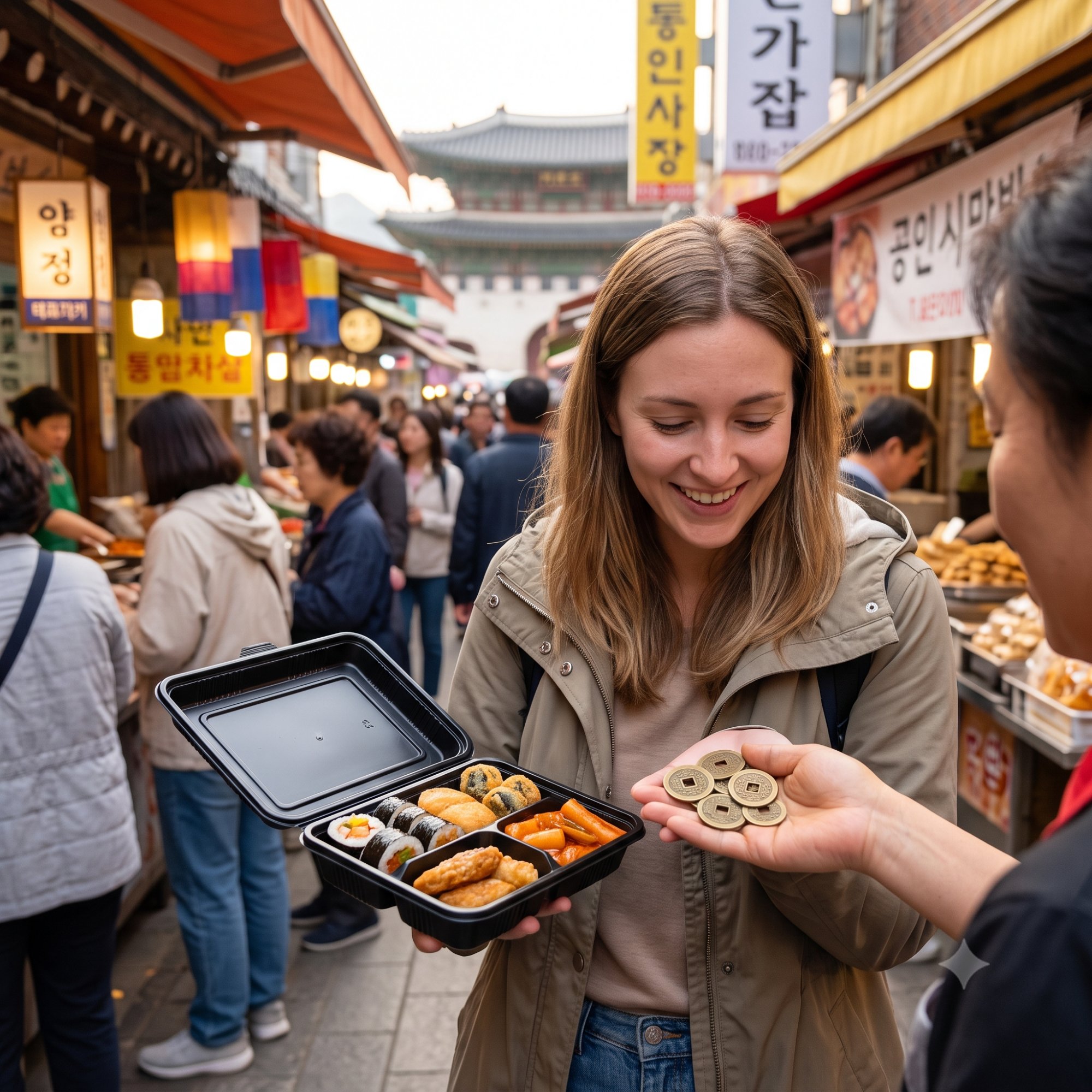
To put it simply, it is a traditional Korean brass coin. Historically, during the Joseon Dynasty, these coins (officially called Sangpyeong Tongbo) were the standard everyday currency. The design is deeply philosophical: the round outer shape represents the infinite sky, while the square hole in the middle represents the earth. They were cast together on a metal branch, and breaking them off made them look like leaves—hence the name "Yeopjeon," meaning "leaf coin." Holding these weighty brass coins in your hand today transforms a simple lunch into a thrilling historical adventure!
The second stop on your Google Maps link is the Customer Service Center. When you arrive at the market, head straight here. You will exchange your modern Korean Won for a string of these historical brass coins and receive an empty black lunchbox tray. This interactive, hands-on experience is wonderfully engaging for families traveling together. Kids are completely mesmerized by the concept of trading ancient treasure for real food, and sharing this unique mealtime makes for unforgettable memories with mom and dad. It is a fantastic cultural lesson cleverly disguised as a fun lunch!
Now, for the most important part:
the food! The third stop on your digital map leads you straight to the most legendary stall in the market: Wonjo Jeontong Halmoni Tteokbokki (Original Traditional Grandmother's Tteokbokki). This is the birthplace of the famous Gireum Tteokbokki (oil-fried rice cakes). Unlike the typical saucy, spicy red tteokbokki found everywhere else, this historic version is stir-fried in a massive iron pan with a savory, lightly spiced oil coating. It is delightfully crispy on the outside and wonderfully chewy on the inside. Since it is exactly pinned on your map, you will not have to guess which stall is the authentic original one!
As you continue down the bustling alleyway, use your remaining coins to grab some Japchae (sweet and savory stir-fried glass noodles) and a crispy assortment of Jeon (Korean savory pancakes). Hand over your Yeopjeon, and the friendly vendors will generously load your tray. Once your tray is overflowing, head back to the Dosirak Cafe seating area to enjoy the feast you personally curated.
After your delicious meal, check the fourth stop on your map: Hyoja Bakery. This is a historic local bakery located right at the end of the market alley, famous for its corn bread. It is an absolute must-visit for dessert. Grab some freshly baked treats before moving on to the final leg of our journey.
The adventure concludes seamlessly in the adjacent Seochon Hanok Village, the final destination on your map. The winding alleys of Seochon are filled with beautiful hanok (traditional houses), cozy tea houses, and hidden art galleries. It is the ideal setting for a post-lunch stroll, perfectly blending the grandeur of the royal palace with the intimate, historic charm of the local village.
Traveling is all about joyful discoveries and immersive experiences. By utilizing this curated Google Maps route that includes all the best eateries, your journey will be perfectly organized, easy to navigate, and completely stress-free. Thank you for joining me on this cultural adventure. This is Mr. Bong from Bong Tour, wishing you a fantastic time in Seoul. Save that map link, get your ancient leaf coins, and let the historical feast begin!
#SeoulTravel #TonginMarket #YeopjeonMarket #SeoulFood #GyeongbokgungPalace #KoreanStreetFood #SeoulTrip #MrBongTour #BongTour #SeoulGuide #TravelKorea #VisitSeoul #SeoulEats #SeoulCulture #TimeTravelSeoul #DosirakCafe #KoreanFood #SeochonVillage #SeoulVibes #TravelWithKids #FamilyTravel #SeoulHistory #ExploreSeoul #KoreaTrip #SeoulLife #SeoulGoogleMaps #TravelMap #SeoulTour #TraditionalMarket #SeoulExperience