
TransportTransit
Korea vs Your Home: Tipping, Plugs, and Getting Around Seoul
Tipping is not expected in Korea. Outlets are 220 volts with two round holes. A short-term Climate Card covers much of Seoul's subway and buses.
Affiliate disclosure Some links are affiliate links (#ad). If you book through them, we may earn a commission at no extra cost to you. Read our affiliate policy
On this page
By Bong Tour Editorial Team · Nov 19, 2026
If you are used to leaving a tip, packing a flat two-prong plug, and tapping a transit card you already own, Seoul works a little differently. Three things catch first-time visitors most often: the bill at a restaurant, the wall outlet in the hotel, and how you pay on the subway and the bus.
QUICK FACTS
Tipping: Not required or expected
Water and side dishes: Asking for more usually does not add a charge
Power: 220 volts, 60 hertz; outlets have two round holes (Type C and F)
Transit: Seoul Climate Card short-term passes — 1, 2, 3, 5, or 7 days
Maps: Naver Map or KakaoMap for walking directions
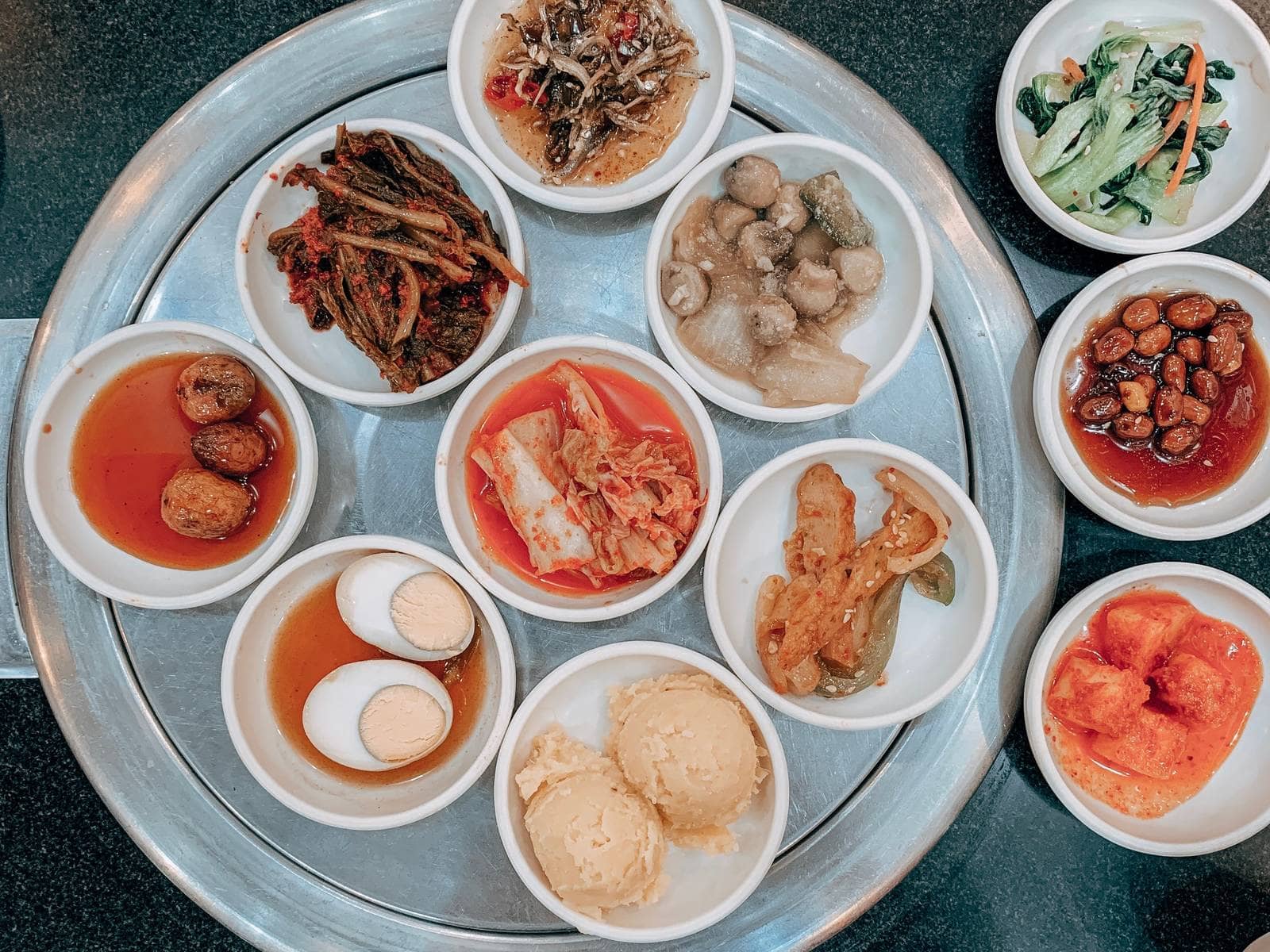
A typical spread of Korean side dishes. Asking for more water or another small plate usually does not add a charge.
Tipping, and what comes with the meal
Tipping is not required or expected in Korea. You pay the amount on the bill and leave. Taxi drivers also do not expect a tip, though some people let them keep the small change.
There is one exception to watch for. At many major hotels and some upscale restaurants, a 10 percent service charge is already added to the bill. Read the receipt before you add anything on top.
The other surprise is what arrives with the meal. A Korean table is usually a main dish, plus several small side dishes — often called banchan — and soup or stew. Kimchi is almost always there. If you want more water or another small plate, just ask. Refills like these do not usually add to the bill. In more and more places you serve yourself water and side dishes, or order at a kiosk.
LOCAL TIP
Look under the tabletop for a small drawer. Spoons, chopsticks, and napkins are often stored there, not set out in a wrap. Many tables also have a call button. It can be louder than you expect, so one press is enough.
At barbecue restaurants, the grill is often built into the table. Some chairs have a hidden compartment under the seat, used to tuck a coat or a bag away from the food.
Plugs: what to pack
Korea runs on 220 volts at 60 hertz, and wall outlets take plugs with two round pins (Type C and Type F, the same shape used in Germany and France). A flat-pin plug from the US, the UK, or Australia will not fit, so pack a travel adapter.
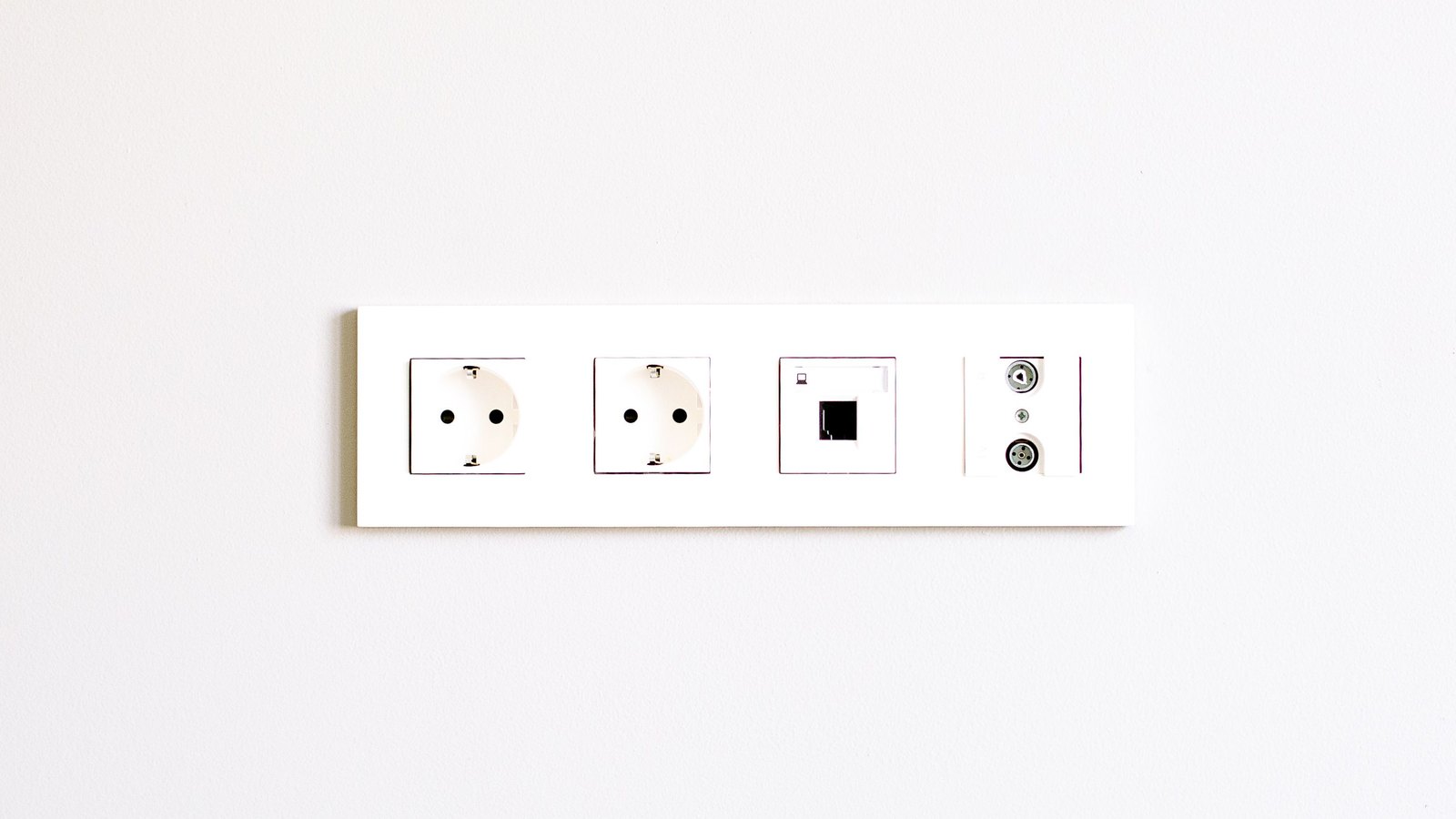
Two round holes: this is the outlet shape your adapter needs to fit in Korea.
Forgot yours? Ask at the hotel front desk to borrow or buy one. Airports, major duty-free shops, retail stores, and convenience stores sell them too.
Getting around Seoul: the Climate Card and the subway
If you will ride a lot during a short stay, look at Seoul's Climate Card short-term pass. It comes in 1-, 2-, 3-, 5-, and 7-day versions, with unlimited rides on the subways and buses it covers.
It does not cover the entire rail map. The main limits, per the official Seoul page:
It covers subway travel at stations in Seoul, and you may get off at Incheon International Airport Terminal 1 and Terminal 2.
You may not board at those airport stations with this card.
It covers Seoul-licensed city and town buses, including late-night and circular buses that fall under that licensing.
It does not cover the Shinbundang Line, GTX, subway stations outside Seoul, or express and airport buses.
The pass starts on the date you recharge it. You cannot load it in advance and hold it for a later day.
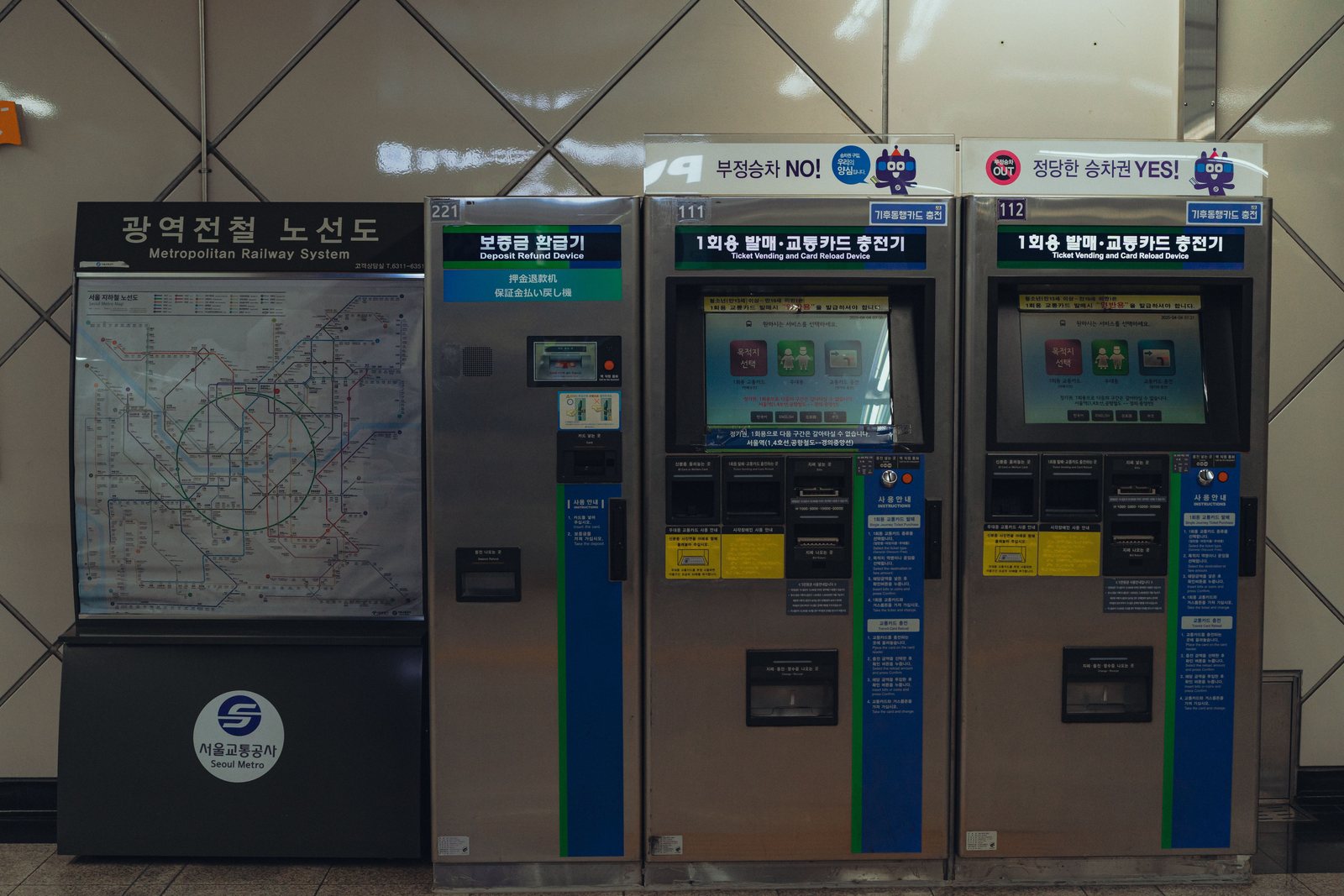
Ticket and transit-card machines at a Seoul Metro station.
You can buy a physical card from the new transit-card vending machines in Seoul Metro stations on Lines 1–8, or at convenience stores near Line 9, Ui-Sinseol Line, and Sillim Line stations. iPhone users need the physical card; the mobile version works on Android 12 or later. The station charging kiosks list cash or a Korean-issued card as payment, so keep some cash for the first charge. Details change, so check the official page before you buy: Seoul Climate Card.
Do not mix it up with the Climate Pass, a separate pass for Seoul residents.
A stored-value transit card such as T-money is still the simple choice if you prefer to pay as you go, or if a trip falls outside Climate Card coverage. You can usually buy and reload one at a convenience store or a station machine.
LOCAL TIP
Google Maps in Korea shows transit routes but not step-by-step walking directions yet. Download Naver Map or KakaoMap before you ride, and search station names in English or Hangul. Color-coded transfer signs in the stations are bilingual, but the walking route underground is easier to follow in a Korean map app.
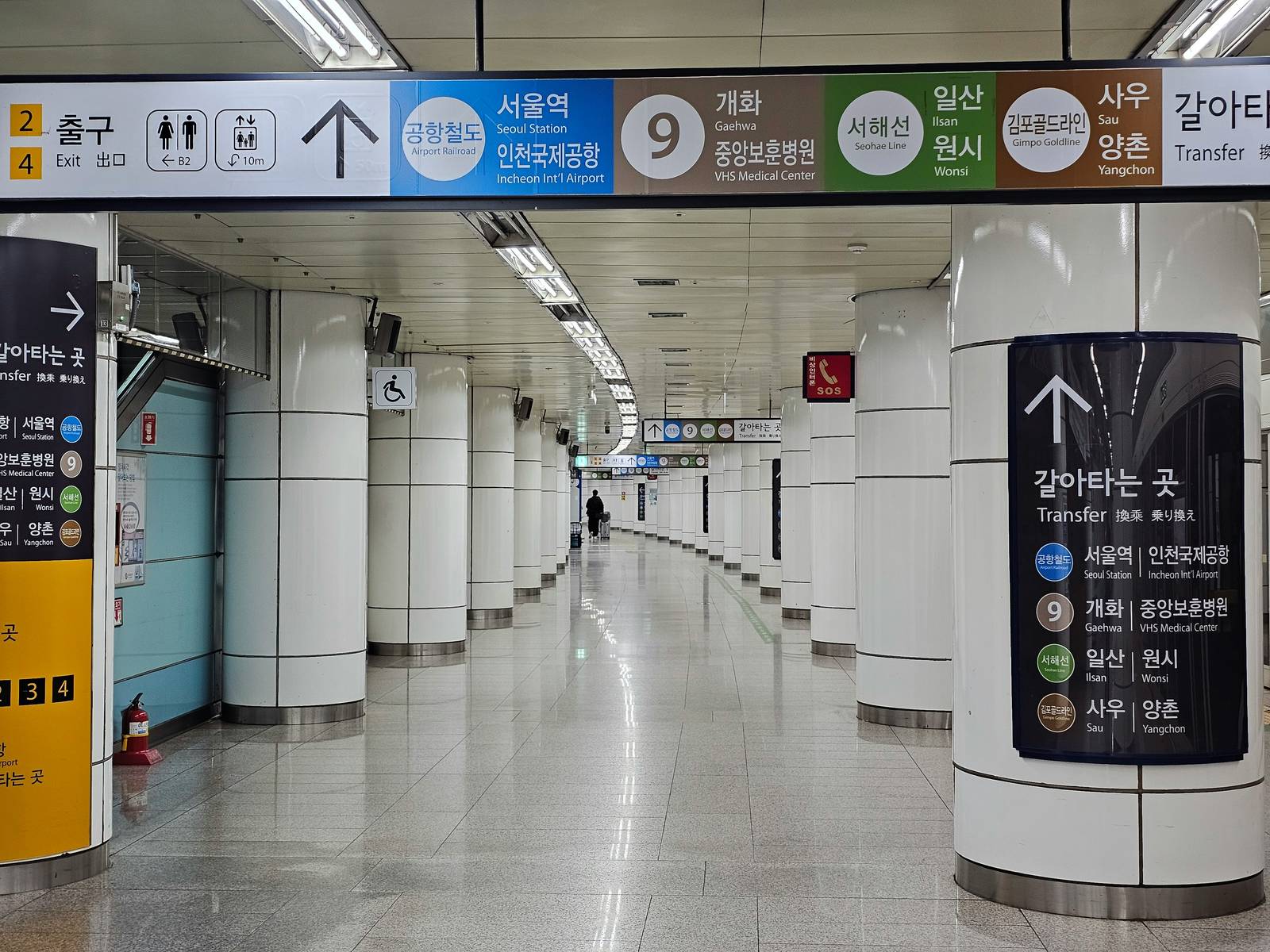
A transfer hall in a Seoul subway station. Bilingual signs help, but a Climate Card covers subway stations in Seoul — not every line or every destination on the board.
How to put this into practice
HOW TO GET AROUND
Maps: Naver Map or KakaoMap. Google Maps in Korea has no step-by-step walking directions yet.
Climate Card: Buy a 1-, 2-, 3-, 5-, or 7-day short-term pass at a station vending machine or a listed convenience store. The pass starts on the day you charge it.
Official how-to: english.seoul.go.kr — search "Climate Card".
From Incheon Airport: You may exit with a Climate Card at Terminal 1 or 2, but you cannot board there with it. Plan a different ticket for the airport-to-city ride.
Taxis: Drivers do not expect a tip. Show the destination in Hangul on your map app.
FAQ
Should I tip in Korea?
No. Tipping is not required or expected. Pay the bill as written. At some major hotels and upscale restaurants, a 10 percent service charge may already be included, so read the receipt first. Taxi drivers do not expect a tip.
Do I have to pay extra for water or side dishes?
Usually not. Asking for more water or more side dishes does not add to the bill.
What plug do I need?
Bring an adapter for two-round-pin outlets (Type C or F). Korea runs on 220 volts at 60 hertz. If you arrive without one, ask your hotel front desk, or buy one at the airport, a major duty-free shop, or a convenience store.
What does a short-term Climate Card cover?
Unlimited rides, for the days you choose, on subway stations in Seoul and on Seoul-licensed buses. You can get off at Incheon Airport Terminal 1 or 2, but you cannot board there with the card. It does not cover the Shinbundang Line, GTX, stations outside Seoul, or express and airport buses. It starts on the recharge date.
Is Climate Card the same as Climate Pass or T-money?
No. In this guide, Climate Card means the city's short-term visitor pass (1 to 7 days). Climate Pass is a separate benefit for Seoul residents. T-money is a reloadable stored-value card you can use ride by ride, including on some trips the Climate Card does not cover.
If you want these details settled before the trip, you can build the rest of the plan with Simplyur Trip.
Related: Landing at Incheon Airport: 7 Things to Do First · 1330 Korea Helpline 2026: When Can You Call in English?
Operated by Bong Tour Co., Ltd.
Related guides
More in Transport
Landing at Incheon Airport: 7 Things to Do First
If you land at Incheon Airport for the first time tomorrow, the next hour goes more smoothly when these seven things are already done. Fill…
Korea Taxi Apps Compared: Uber, Kakao T, k.ride
Mr. Bong from Bong Tour here, ready to share the ultimate transportation secrets for your upcoming South Korean…
Namsan Night Walk on Nov 21: Walk-In Evening Trek in Seoul
Seoul's Namsan Night Trail is Saturday, Nov 21, 2026. Register from 6 PM at Namsangol Hanok Village. First 700 walk about 3 km to Namsan Octagonal Pavilion.